


Why Finding a Service Still Depends on “Do You Know Someone?”
Service discovery still relies on contacts and referrals. Learn why this limits choice and how structured systems improve visibility and access to better vendors.
You need a service. But you don’t know where to start.
Something at home needs fixing. Your first instinct is not to open a platform. It is to ask someone you know. You check old chats, scroll through contacts, or ask a neighbour. Eventually, someone shares a number.
You call. You hope it works.
👉 Why does service discovery still work like this? Because most people don’t start with a system. They start with memory.
How Service Discovery Actually Happens Today
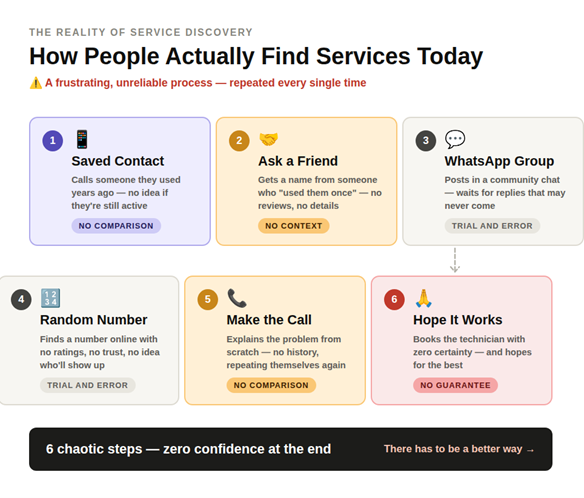
When you need a technician, your options don’t feel wide. They feel limited and scattered. Not because vendors don’t exist, but because you can only access what is already within your personal network.
Most discovery still happens through:
- Saved contacts from previous work
- Recommendations from friends or neighbours
- Numbers forwarded in WhatsApp groups
- Someone you vaguely remember using
At first glance, this feels simple and convenient. But when you step back, you realize something important.
👉 You are not exploring options. You are repeating patterns.
This means discovery is not driven by choice. It is driven by availability within your circle.
Why This Feels Reliable but Isn’t Scalable
The “do you know someone?” approach feels safe. There is a sense of trust because someone else has used that service before. It reduces hesitation and gives you a starting point.
But this trust is often shallow. It is based on someone else’s experience, a different requirement, or a different home setup. What worked for them may not work for you.
At the same time, you are limiting yourself to a very small pool of options.
👉 The system feels reliable, but it is not scalable.
The Hidden Cost of Limited Discovery
This approach does not fail immediately. It works just enough to continue. But over time, the limitations start showing up.
You may notice fewer choices when you need something specific, difficulty comparing quality or pricing, inconsistent service outcomes, and repeated trial and error.
👉 These are not isolated issues. They come from the same root problem: discovery is narrow, and it stays narrow.
Good vendors who are not part of your network never appear in your decision process.
Why Good Vendors Stay Invisible
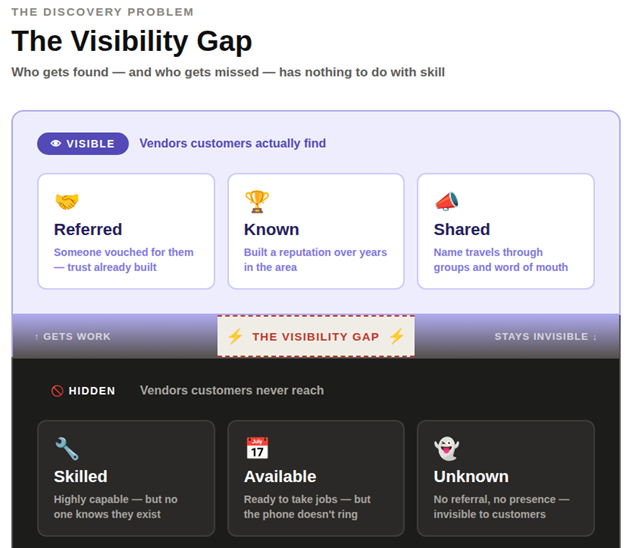
This problem affects vendors just as much as customers. Many skilled technicians are not struggling because of lack of ability. They are struggling because they are not visible.
Their business depends heavily on word-of-mouth referrals, repeat customers, and local connections. If they are not part of active referral circles, their growth slows down. Even if they provide better service, they remain outside the discovery loop.
👉 Their limitation is not skill. It is visibility.
The Real Gap: No Structured Discovery Layer
The issue is not just about finding a technician. It is about how discovery itself is designed. Right now, discovery is private, fragmented, and dependent on personal memory.
There is no shared system where demand and supply meet efficiently. Customers are searching blindly. Vendors are waiting to be found.
👉 This is not just a search problem. It is a demand capture problem.
What System-Driven Discovery Changes
When discovery becomes structured, the entire experience shifts. You move away from uncertainty and toward clarity.
Instead of asking around, guessing availability, or trying random contacts, you begin to search based on need, explore relevant options, and compare before deciding.
👉 Discovery becomes intentional instead of accidental.
How FatafatService Solves This Gap
FatafatService introduces structure into how services are discovered and accessed. It does not just give you options. It creates visibility across the ecosystem.
1. Marketplace Layer: Expanding Visibility
Instead of relying on private contacts, the marketplace creates a public discovery layer. Customers can search for services by category and explore multiple vendors.
👉 Vendors move from being hidden to being discoverable.
2. Vendor Profiles: Building Identity
A phone number becomes more than just a contact. It becomes a structured profile that represents the vendor, including service categories, areas served, and nature of work.
👉 This builds confidence and reduces uncertainty.
3. Geo Relevance: Matching Real Needs
FatafatService focuses on local availability and area-based filtering, ensuring that discovery is practical, not just theoretical.
4. Moving Toward Smarter Discovery
As the system grows, discovery becomes more refined, including better ranking of vendors and category-based matching.
From Contacts to Systems
The biggest shift is not technological. It is behavioral. You move from “Do you know someone?” to “Let me find the right person.” This removes dependency on memory and replaces it with structured access.
👉 You are no longer limited by your network. You are guided by a system.
Why This Shift Matters
When discovery improves, the entire ecosystem benefits. Customers get more choice, better clarity, and faster decisions. Vendors get more visibility, fairer opportunities, and consistent demand.
👉 Efficiency increases on both sides.
The Bottom Line
The problem is not that people cannot find someone. It is that they cannot find the right someone. And that happens because discovery still depends on personal networks instead of structured systems.
👉 The future of home services is not built on contacts. It is built on visibility.
👉 Still relying on saved numbers and WhatsApp forwards to find services? Move to a smarter way of discovering local service providers with FatafatService.
FAQs
1. Why do people still rely on contacts for finding services?
Because structured discovery systems are not widely used, so people depend on personal networks for quick recommendations.
2. What is the limitation of referral-based service discovery?
It restricts visibility and choice, making it harder to find the most suitable service provider.
3. How can I find the right service provider without relying on contacts?
FatafatService lets you search for services based on your need and location, helping you discover options beyond personal referrals.
4. How does FatafatService help vendors grow their business?
It gives vendors a visible profile where they can showcase their services, areas served, and build trust over time instead of depending only on word-of-mouth.
5. What makes FatafatService better than traditional service discovery?
Unlike contact-based discovery, FatafatService provides a structured system where customers can explore, compare, and choose vendors with better clarity.